Clubbed Tunicate
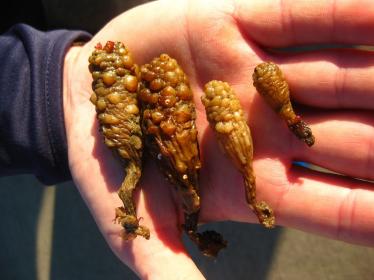
[Image: Jeannine Fischer, MPI]
Â
Status in New Zealand
Present in some areas of New Zealand
Legal status:
Under management
Description
The clubbed tunicate is an ascidian that grows on both natural and artificial hard marine surfaces. It is most commonly observed on wharf pilings, aquaculture structures, ropes and vessel hulls. They may also be found attached to rocks, seaweed and on shellfish. The clubbed tunicate is found in low energy environments such as ports and harbours and it has wide physiological tolerances. It has been found to reach high densities of 500-1500 individuals per square metre and is an efficient suspension feeder. Because of these two features it can outcompete other species for habitat and food.
Why is it a problem?
The clubbed tunicate can outcompete other species due to it reaching such high densities and being an efficient suspension feeder. As a fouling organism it can decrease the productivity of cultured species and increase aquaculture processing and harvesting costs. It also results in higher fuel and maintenance costs for vessels. In Japan it has caused asthmatic symptoms in individuals who shuck fouled oysters in poorly ventilated areas.
A vessel discovered by Marlborough District Council with significant numbers of Styela clava present on the hull.
What do they look like?
Key Features
|
 |
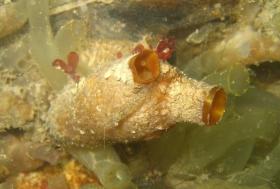
Download an identification guide
Find out more about this species
- Smithsonian Environmental Research Center NEMESIS database
- CABI Invasive species compendium
- MPI Sea squirt
Related content
-
Gust, N., Inglis, G., Floerl, O., Peacock, L., Denny, C., Forrest, B. (2008). Assessment of population management options for Styela clava. MPI Technical paper No: 2009/04. 236 p. ISBN No: 978-0-478-33871-3 [PDF 3.5 MB]
- McClary, D., Phipps, C., Hinni, S., (2008). Reproductive behaviour of the Clubbed Tunicate, Styela clava, in northern New Zealand waters. MPI Technical paper No: 2009/01. 40 p. ISBN 978-0-478-33838-6 [PDF 1.3 MB]