National Marine High Risk Site Surveillance
Objectives
The objectives of the NMHRSS are to:
-
detect incursions of high risk non-native organisms (those listed on the national register of Unwanted Organisms) that are not known to be present in New Zealand.
- detect incursions of other non-native or cryptogenic organisms that have not previously been recorded in New Zealand, and
- detect range extensions by established non-native or cryptogenic organisms that exhibit characteristics of pests.
Read more about some of these species on our Marine Pests pages.
High Risk Sites
As the name suggests, the NMHRSS is undertaken in some of New Zealand's busiest ports and marinas of first entry for international vessels. These are the sites where incursions by marine species not currently in New Zealand are most likely to occur. Twelve harbours are included in the programme. Sampling within each harbour is focused on the habitats and locations where the primary target species are most likely to occur.
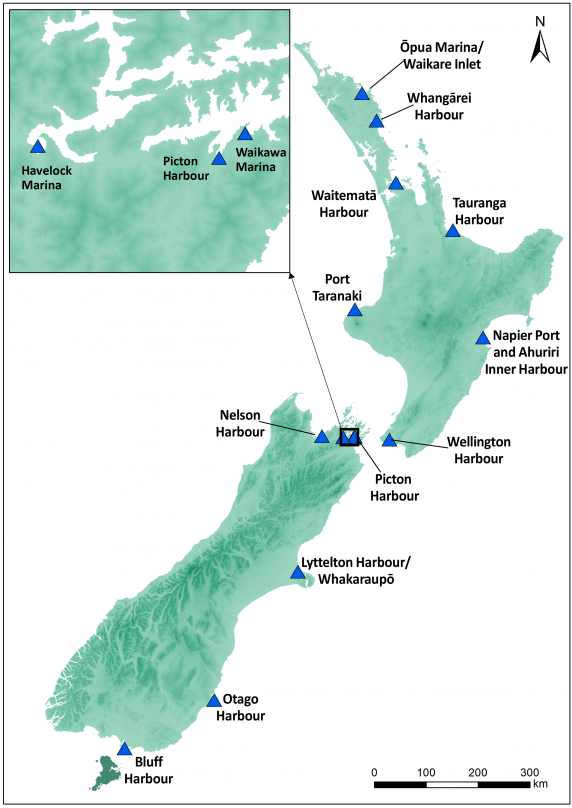
Survey Methods used in the National Marine High Risk Site Surveillance
Survey methods used in the NMHRSS have been chosen to optimise detection of the primary high risk species. An important consideration was the efficiency with which samples could be taken in the field since the chances of detection are greatest when a large number of samples can be taken.
Related reading
- National Marine High Risk Site Surveillance - Annual Synopsis Report for all High Risk Sites 2024–25 Download document [PDF, 27.6 MB]
- National Marine High Risk Site Surveillance - Annual Synopsis Report for all High Risk Sites 2023-24 Download document [PDF, 21 MB]