Wakame Asian Kelp
[Image: Te Papa]
Status in New Zealand
Present in some areas of New Zealand
Legal Status in New Zealand
Under management
Description
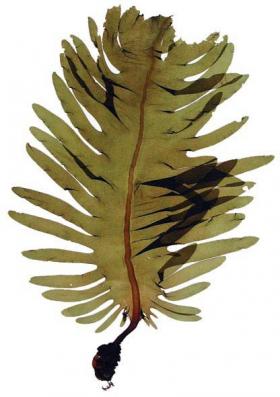
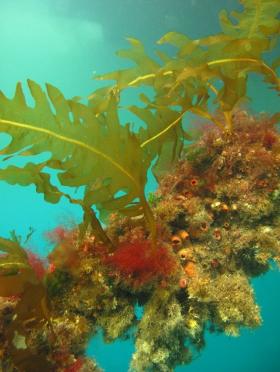
Asian kelp is native to Japan where it is cultivated for human consumption. It is spread mainly by fouling on vessel hulls and is present in almost all of New Zealand's international ports and harbours ranging from Auckland down to Bluff including many offshore island. With the exception of Fiordland it is currently not known to have established on the West Coast of the South Island, or large areas of the North Island's West Coast. Asian kelp grows from the low intertidal area to subtidal depths of around 15 metres. It grows on any hard surface including shells, reefs, ropes, wharf piles, vessel hulls moorings and other artificial structures. It can form dense "forests" in sheltered reef areas.
Educational video about Undaria pinnatfida from the Monterey Bay National Marine Sanctuary.
Why is it a problem?
The impacts of Asian kelp are not well understood and are likely to vary depending on location. It can form dense stands under water, potentially resulting in competition for light and space which may lead to the exclusion or displacement of native plant and animal species. It also has the potential to become a nuisance for marine farms by increasing labour and harvesting costs due to fouling problems.
|
 |
Download an identification guide
Find out more about this species
Related content
- Neill, K., Heesch, S., Nelson, W. (2008). Diseases, pathogens and parasites of Undaria pinnatifida. MPI Technical paper No: 2009/44. 108 p. ISBN 978-0-478-35753-0 [PDF 2.5 MB]
Additional Reading
- Heesch, S., Broom, J., Neill, K., Farr, T., Dalen, J., Nelson, W. (2007) Genetic diversity and possible origins of New Zealand populations of Ulva. MPI Technical paper No: 2007/01 High resolution [PDF 45 MB]; Medium resolution [PDF 24 MB]